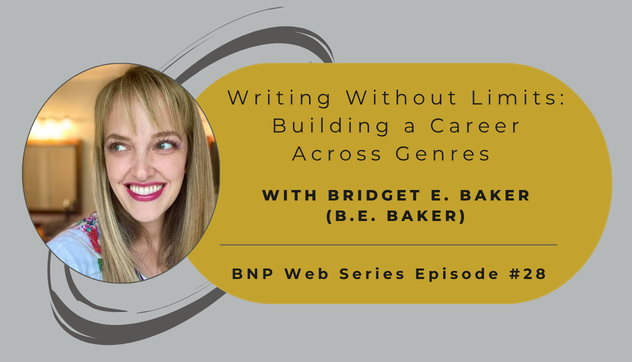
In this episode of the B&N Press Web Series, bestselling author Bridget E. Baker (also writing as B.E. Baker) joins us to explore what it means to build a successful writing career across multiple genres.
From fantasy and science fiction to contemporary romance, women’s fiction, and historical fiction, Bridget has built her career by following the stories that inspire her—even when conventional publishing advice says authors should pick a lane. In this candid conversation, she shares what she has learned about balancing creativity with business, bringing readers across genres, building a recognizable author brand, and knowing when a pen name makes sense.
If you have ever felt pulled toward a story that does not quite fit your established genre—or wondered whether branching out could confuse your readers—this conversation is a reminder that there is more than one way to build a sustainable writing career.
Key Takeaways
● Writing across genres can strengthen your craft. Lessons in character development, pacing, plotting, and emotional stakes can carry from one genre into another.
● Your author brand can extend beyond genre. Voice, writing style, themes, character development, and the reader experience can create consistency across very different books.
● Understand reader expectations before entering a new genre. Everything from cliffhangers to character names can land differently depending on the audience.
● Pen names can create a helpful “bright line” between books with significantly different audiences, content, or reader expectations.
● Covers and packaging matter. Creating visual consistency between genre-adjacent series can help readers recognize which books may deliver a similar experience.
● Not every book or series has to perform equally. Experimenting with a new genre does not erase the success you have built elsewhere.
● Do not let fear of failure keep you from trying something new—but be realistic about your capacity. Branching out creatively and stretching yourself too thin are two very different things.
Transcription
Julie Braunschweiger: Hello and welcome! Today, I am sitting down with bestselling author Bridget E. Baker, or B.E. Baker, to explore what it means to build a successful writing career across multiple genres.
While many authors are encouraged to pick a lane, Bridget has built her career by following the stories that inspire her, writing everything from fantasy and science fiction to contemporary romance, women’s fiction, and historical fiction.
A lifelong storyteller who briefly pursued a legal career before becoming a full-time author, Bridget is known for creating compelling characters and imaginative worlds that resonate with readers of all ages.
Bridget, welcome, and thank you for being here with me.
Bridget E. Baker: Yeah, you make me sound better than probably—
Julie: You’re like, “Other people are encouraged to pursue one lane.” And you’re like, “Oh, I was too.”
Bridget: I was too!
Julie: Well, we can get into that. That’s the whole point, I think. Today, we’ll be talking about the creative and business lessons learned from writing across all these genres—being told to stick to one lane, but then busting loose, and the freedom that comes with writing without limits.
So let’s dive right in. Did you always plan to write multiple genres? It sounds like no.
Bridget: No. Actually, before I became indie, I was only pursuing traditional publishing. There’s a whole lot of advice out there in traditional publishing, but I think the number one rule I heard from more places than I could even keep track of was: Don’t try to write to market. Don’t try to write certain things. Just tell the story of your heart.
I heard that all the time.
The reality is that the publishing world is too complicated to explain in sound bites. Ultimately, agents and publishers want to have the ability to package those books where they think they need to go.
But as soon as you start looking into indie publishing, everybody is telling you: Number one, build a brand. Number two, stick to that brand.
And it makes sense. If you’re thinking, “For dinner tonight, I want Mexican food,” you’re not thinking you want lasagna. You’re thinking tacos, enchiladas, fajitas. That’s what you’re expecting.
So if you go to get Mexican food and they say, “Let us tell you about our extensive Italian menu,” you’re going to say, “I don’t want to hear about your Italian menu. I came here for Mexican food.”
There’s a reason they tell you that.
But I had already been a lawyer for ten years. I was doing really well when I finally decided I just didn’t want to do it anymore, and I had enough money saved from working hard as a lawyer that I could do what I wanted.
And what I wanted was not to write the same book in a cookie-cutter repeat. I wanted to write anything that appealed to me.
After spending years with an agent trying to get published, suddenly I didn’t have anyone telling me what I had to do. I was like, “Wait, I get to do whatever I want to do?”
And then I did.
If you imagine releasing an eight-year-old into a candy store and saying, “Mom’s not here to tell you it’ll rot your teeth. Go crazy,” that was basically me. I was an eight-year-old in a candy store, and I was writing what I wanted to write.
There’s a business philosophy that says the key to success isn’t making a product and then figuring out how to sell it. It’s figuring out what the market wants and then making that product.
Basically, the opposite of what I was doing.
All I ever wanted to do was make my little widgets, want them to be wonderful, and then find someone who would buy them. That’s a much more difficult task than going out and figuring out what people want and then making that.
The problem is, if you’re an indie, books are the intersection of business and art.
From my perspective, in order to create a good widget, I needed to be making art that I wanted to make. I tried a couple of times writing something I thought people wanted. I’m not good at that.
What I’ve decided is that I need to be an artist, and then I need to put on my business hat and figure out how to sell my weird widgets.
Julie: I love that. That’s the beauty of being an indie author. If you want to follow your heart and write the story you’ve always wanted to write, you can do that. But you also have to balance the business portion of this industry.
When you’re trying to figure out what to write, what attracts you to these different types of stories? You write across so many genres. Why do you write in all of them?
Bridget: To me, I’m always looking for a compelling story.
When I first started writing, I heard somebody say, “The characters were talking to me,” and I thought, “Yeah, right. What a lunatic.”
The more I’ve gotten into this, though, the more I start thinking about things from a character’s perspective. Now I do kind of hear the characters talking to me. When they start talking, my husband is like, “Oh, you’re about to be writing, aren’t you?”
I’m like, “I’ve got to start writing it down.”
I had pretty much solidified into women’s fiction or romance under B.E. Baker and fantasy—always set on Earth, so urban fantasy—under Bridget E. Baker. I was trying to stay in my two big, not-well-defined lanes.
Then I was doing research for a dragon shifter romance. The theme was: What makes a monster?
My main character thinks the dragons that invaded Earth are monsters, but she’s starting to question that. So I was researching things that could connect to that theme, and I thought about the Donner Party.
I started researching it and fell into an absolute hole.
There were journals, letters, interviews with survivors—a tremendous amount of firsthand information. But I couldn’t find the kind of story I wanted to read: something that really told it from the people’s point of view, particularly the women’s perspectives.
Suddenly I told my husband, “I think I’m writing a book about the Donner Party.”
He said, “How would you publish that?”
And I said, “I don’t know.”
It wasn’t a romance. It was historical fiction. I had to call it fiction because, even though the facts were correct, there were things nobody knows where I had to fill in the blanks.
That book took months and months of research and writing. I bought copies of source material. I was reading the actual letters and journals.
How did it happen? That story grabbed me and basically said, “You will tell this.”
And that’s kind of what happens with the other stuff, too.
The dragon shifter series I had been researching for wasn’t even due yet. I was writing two other fantasy stories. But that main character—an MMA fighter—started talking to me, and she wouldn’t shut up.
One night, I thought, “I’m just going to write the first chapter or two so she’ll leave me alone.”
I wrote that book in a week and a half.
Why do I write in multiple genres? Because I became a writer because I didn’t like practicing law. It wasn’t a business decision.
I’ve been able to turn what I do into a successful business, in spite of all my stupid decisions, but it’s something I love because I write the stories I want to write.
I write eight to ten books a year, and I credit being able to write that many largely to the fact that I’m writing things I really, really want to write—stories that speak to me, whatever genre they happen to be in.
Julie: Has there ever been a point where you developed an idea or character for one book and then realized they should actually be in another genre or another series?
Bridget: I haven’t switched midstream and made it a different story, but I have changed things.
My husband and kids are the most supportive people in the world, and they read all my stuff. Because I outline everything—including my series—sometimes they sneak in and read my outlines.
There was a beloved character who was going to die. They lost their collective minds.
My husband’s dad had just died, and he said, “This will break me. You cannot kill this character. I will never forgive you.”
I thought he was kidding. He was serious.
So I had a character whose death was absolutely required by the plot, and I didn’t kill that person off.
My family can be a microcosm of my readers because they are my readers, too. They had such a strong reaction that I thought maybe my fans wouldn’t forgive me either.
Another thing they kept bugging me about was crossing over my series.
I have a horse shifter fantasy romance series, My Queendom for a Horse, and my husband kept joking that I should cross it over with my women’s fiction.
I thought, “How? Two widows on a ranch in the western United States, and I’m going to cross that over with horse shifters in Latvia and Russia?”
They joked about it for probably two years.
Then, while I was outlining book four, I suddenly thought: I could cross it over. And this is how I would do it.
So I did.
The characters go to America and end up at Birch Creek Ranch, and two of the characters who are kids there become the main characters in books five and six of the horse shifter series.
I thought there was no way the audiences would cross over. My target demographic for Birch Creek Ranch is probably women forty and up, while the horse shifters are probably women twenty to forty.
But I’ve had an awful lot of people say, “Wait, I loved Birch Creek Ranch. You’re saying I can read about those characters if I try these?”
They’ll try them.
My editor once described My Queendom for a Horse as women’s fiction if women’s fiction had men who could shift into horses. It reads like women’s fiction, but there’s magic in it.
I call it my gateway drug because I’ve successfully convinced maybe ten to twenty percent of the people who read my women’s fiction to try it.
One of my top-selling special editions is actually the Birch Creek Ranch series with My Queendom for a Horse added on. They try that book, and if they like it, they come back and buy the others.
That’s been really interesting from a marketing perspective.
Julie: When you’re writing in these different genres, do you carry lessons from one into another? How do they impact each other?
Bridget: I always try to have a character development and growth arc in each book that is complete for that book. Because I write predominantly in series, I also need a series growth arc if that character appears in multiple books.
Then I need a plot for the book and the series that develops and ties into that character growth. I also try to include a theme.
What I hear from people a lot about my fantasy is, “It had a lot more emotional impact than I’m used to finding in fantasy.”
I think that’s because what I’ve learned in women’s fiction has pulled through.
Then the number one comment I get on my women’s fiction is, “So many things happen. There are so many twists and turns.”
That’s a fantasy thing.
I try to plot my outline so something surprising happens at the end of every chapter.
When new writers ask me how long their chapters should be, I say they need to be as long as they need to be.
Two things have to happen in every chapter. You need some kind of development—good to bad, bad to good, bad to worse, good to better—for the character. And then you need a surprising change at the end.
Why is the chapter there if that’s not happening?
It should be really hard for people to put your book down because something surprising happens at the end of every chapter.
I do that in my women’s fiction, and I bring themes and character growth into my fantasy.
That helps my readers cross over because they know what they expect from my fantasy books is also going to be present in my women’s fiction, and vice versa.
Julie: So what you’re bringing readers, even across different genres, is a voice and style of writing that carries over.
Bridget: Exactly. The genres are different, but there’s consistency in the writing style.
I don’t write bogged-down paragraphs of description. I’ll write one line that hopefully gives you information about the character or puts you in a setting.
I also use a lot of similes and metaphors. People either like that or they’re bugged by it. But if they like it, they’ll like it in my fantasy and my women’s fiction because that stays the same.
Julie: Have you found that writing in certain genres strengthens particular writing skills that you can then use moving forward?
Bridget: Definitely.
When I first started writing, my writing was awful. Editors and agents would give me tips and recommend craft books. I’d go read them and think, “Oh no, my book is terrible.”
Then I’d edit my entire book, fixing the things I realized I was doing wrong.
The next time I wrote, I didn’t make those same errors because I had learned through fixing them.
That continues now. If I learn the weakness in a particular series, I clean it up, and then when I write another series I think, “How can I apply this here?”
I also think writers can learn a lot from watching other kinds of storytelling.
I used to read constantly. I still read, but now I spend so much time looking at a screen and editing that I’m more selective. When I need a break, I’ll binge something on Netflix or Amazon Prime, and if I’m watching something compelling that I can’t stop watching, I take notes on why.
If I see a fantasy romance handle a morally gray character really well, I’ll think, “How could I apply this to a modern-day story? How could I create someone morally gray who isn’t murdering people and give them a redemption arc tied to my main character?”
Those are things you don’t necessarily see in women’s fiction, which can make the story feel unique.
I think all of that has helped me make my bizarre, drunken-squirrel approach to writing actually work.
Even though I’m basically saying, “Hey, I know you came to me for tacos. Want to try this lemon parfait? It’s also by me.”
Julie: That can also help with marketing. If readers love certain people or certain elements, you can point them toward another series.
But what challenges come with marketing books in multiple genres?
Bridget: Oh boy. It’s so much harder.
Any author who has put out a handful of books knows your easiest marketing is book one to book two. And your main marketing is selling readers happily on the book and making sure you’re fulfilling their expectations.
But those expectations change by genre.
In fantasy, fans don’t get that bent out of shape about a cliffhanger. They know there will probably be a big unresolved question because it’s a fantasy series.
If you’re writing women’s fiction and leave readers on a cliffhanger, they will eat you alive.
My first women’s fiction book taught me that.
I sent it to my friend Pamela Kelley, who has done extremely well in women’s fiction, and asked her to read it.
She messaged me and said, “Bridget, I like you, which is why I’m telling you this awkward thing, but your ending sucks.”
I said, “What do you mean? There’s a book two!”
And she basically told me nobody was going to read it because I had ended the first book with all this bad stuff happening.
She said, “These women’s fiction readers are reading for a hit of dopamine in their lives, and you are not giving them that.”
I had about two weeks until publication and had to write an entirely new chapter, get it to my narrator, have it recorded, mastered, and proofed. It was a mess.
Pam had also warned me that my two main characters were named Amanda and Abigail and that women’s fiction readers would get confused.
I ignored her.
That was stupid.
The number one critical comment on that entire series is, “I have a lot of trouble keeping the characters’ names straight.”
Pam was right.
I had read a lot of women’s fiction, but I hadn’t read it from a writing perspective, and I hadn’t gone in and studied what readers complained about.
That taught me something important: If you’re going to write in a new genre and you haven’t consumed so much of it that you’d consider yourself an expert, find someone who has.
Julie: Speaking of names, you write under two different names: B.E. Baker and Bridget E. Baker. When should authors consider using a pen name?
Bridget: It depends on your goal.
I think if you’re writing at two very different spice levels, you need a pen name. If some books are no-spice or very low-spice and others are high-spice, you need a bright line.
Managing another pen name is complicated, though.
You have to decide: Do I need two websites? If I sell direct, do I need two stores? Do I need separate Facebook, TikTok, or Instagram profiles?
At first, I had everything under Bridget E. Baker.
But I started getting messages and reviews from readers. My fantasy readers cross over into my women’s fiction more often than my women’s fiction readers cross into fantasy.
I have a lot of readers in their fifties, sixties, seventies, and eighties reading my women’s fiction, and some of those people simply do not want fantasy.
They needed a bright line so it would be easy to tell what was what.
So the rule became: Could happen in the real world? B.E. Baker. Couldn’t happen in the real world? Bridget E. Baker.
Of course, then you get books that don’t fit perfectly.
My Sins of Our Ancestors series is post-apocalyptic. There’s not a speck of magic, but it isn’t the real world as it exists now, and the main character is seventeen. So I put it with Bridget E. Baker and called it speculative fiction.
Then you write a Donner Party book and think, “Where the heck does that go?”
Or a picture book.
When you write a lot of genres like a crazy person, eventually you just have to decide where you’re going to put things.
Julie: How do you keep your brand consistent across these different names?
Bridget: I have things that are on brand and things that aren’t.
The things that are on brand, I market more heavily.
I have a picture book that came from a story I always told my son, and my husband illustrated it. Once or twice a year, I mention it to my newsletter and sell some copies, but I don’t talk about it otherwise.
It doesn’t fit my brand.
That gets harder the more broadly spread you get.
Another issue is covers.
When a reader finishes one series and is deciding whether to pick up your next series or read something else on their limitless TBR, if two series look similar from a branding perspective, they’re more likely to pick up the second one.
They think, “That looks like it will be similar to this thing I liked.”
So I try to make sure the branding from one series to the next is similar.
My women’s fiction sells a little better than my contemporary romance, but I think they deliver a similar reader experience. My readers often call them all romances anyway.
So I decided to make the branding on my contemporary romances look very women’s-fiction-y.
My Birch Creek Ranch books have ranches, horses, sunsets, and barns. Then readers go into my Finding Home series, which uses doors and windows with similarly styled typography.
It doesn’t feel like a huge disconnect.
I had another romance series, Scarsdale Fosters, with more traditional romance covers—couples on the front—and it did not sell well.
I was getting ready to shut the series down because it wasn’t selling.
Then I thought, maybe I need to rebrand it so it looks like everything else.
I changed the covers to wreaths on doors and retitled the books with titles that felt more like women’s fiction.
My sales doubled.
Now the people I bring in through my other books move through that series, too.
That’s something to think about if you’re writing multi-genre but don’t want five pen names.
Julie: I think there are two takeaways there. If you have a long-running series that’s stuck, rebranding the covers can potentially give it new life. And if you’re writing across multiple genres, visual branding can help lead readers from one series to the next.
We’re coming to the end, so I want to do a lightning round.
Favorite genre to write?
Bridget: Oh boy. People ask me that a lot.
I don’t have a favorite food. I have the food I’m in the mood for. And that’s how I feel about genres.
If I were making the smartest business decision, I would stop writing fantasy entirely and just write women’s fiction. I make probably sixty percent of my money on women’s fiction and forty percent on fantasy, even though I split my efforts pretty evenly.
So why haven’t I stopped writing fantasy?
Because I really like writing fantasy.
Fantasy takes a lot out of me, though. It’s exhausting.
Then you could say I should stop writing romance because my women’s fiction outsells my romance, too.
But I get something different out of romance.
The romances are easy and fun for me to write—not easy in the sense that the book itself is easy, but there are fewer moving parts. I can sit down, write it, and think, “That was fun. I want to write another one.”
Women’s fiction is more complicated. I have multiple point-of-view characters, and each needs a plot and character arc tied around one central theme.
It’s more rewarding for me to write, but it’s also harder.
Sometimes I just want to sit down and write something fun.
I tried writing two women’s fiction books back-to-back once because they sold better. It took me twice as long because I was tired. My brain hurt. I had to delay the book twice.
I would have been better off writing a romance in between and then coming back.
Some of my writing acts as a palate cleanser for my brain.
So which one is my favorite?
Whichever one I’m in the mood for right now.
Julie: Okay, then what is a genre you’d like to try?
Bridget: Julie, you’re trying to get me in trouble.
I have a lot of friends who tell me, “Your books are so funny. You could just call them rom-coms if you wanted.”
Then I had a rom-com idea.
And then I had another completely different rom-com idea.
I completely outlined both of them and put them in a lockbox because I thought, “Bridget, no. The last thing we need to do is add another B.E. Baker genre.”
So if I were going to branch out into something else, it would be the rom-coms that keep bugging me.
But they’re in lockdown right now.
Julie: I look forward to those eventually seeing the light of day!
Last but not least, what is one piece of advice for authors who might be afraid to branch out?
Bridget: If you’re afraid to branch out because you’re stretched too thin and don’t have time, don’t do it.
If you’re afraid to branch out because you’re worried your book might fail—maybe you’ve found success in another area and think failure would be embarrassing—that’s what pen names are for, my friend.
Don’t make the decision out of fear.
If you’re afraid of stretching yourself too thin, that threat is very real. I have a lockbox for a reason. I cannot go another direction right now.
But if you’re afraid because you think you might fail, you might fail.
And it’s okay.
I have had plenty of series fail. They haven’t kept my other series that have done great from doing well.
Your failure in one area will not mean failure elsewhere as a writer.
It’s okay to try something new and have it not do that great. You’ll be just fine.
Julie: Bridget, thank you so much for joining me and sharing all of your expertise.
And to everyone watching, be sure to check out Bridget’s wide variety of amazing books. You can connect with her online and on social media to find out more, and of course find her books on BN.com and NOOK.
I hope today’s discussion inspires anyone watching to take a chance on something new and build the writing career you want on your own terms.
Bridget: I did just want to say how much I appreciate Barnes & Noble. They are a phenomenal partner to work with, even for multiple pen names.
They’ve been as supportive as any platform could possibly be at helping me get the word out and do promotions for any of my pen names, without saying, “Oh, well, this isn’t the same as your others.”
They’ve been really, really wonderful about it.
I can’t end this without saying how great Barnes & Noble always is to work with. It’s wonderful to have a partner that cares about the writers, too.
Julie: We do. We care about our writers. We believe in our writers, and we believe in the books that you guys write.
Thank you, and until next month, everybody. Bye!
Editor’s Note: This transcript has been edited for clarity, length, and readability while preserving the intent and substance of the original conversation.


