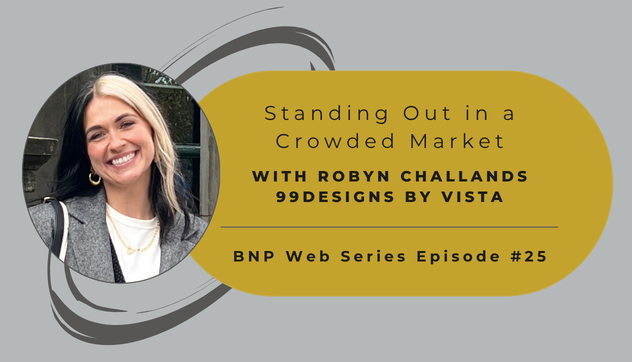
With more books being published than ever before, standing out is no longer optional and thanks to 99designs by Vista, they make it easier than ever. While a compelling story is the foundation, what gets a reader to stop, click, or pick up your book often comes down to one thing: design.
In this episode of the B&N Press Web Series, we sit down with Robin Challands, Head of Brand and Communications at 99designs by Vista, to explore how thoughtful, strategic design can elevate your book and help it connect with the right readers.
With over fifteen years of experience in branding and content marketing, Robin shares practical insights into cover design, author branding, and how indie authors can compete in today’s crowded marketplace.
Key Takeaways
● Your cover is your most powerful marketing tool. Readers make split-second decisions, and a strong cover signals genre, tone, and quality instantly.
● Design is storytelling. Color, typography, and imagery work together to communicate what your book is about before a reader reads a single word.
● Do not treat cover design as an afterthought. Starting early leads to stronger, more cohesive results.
● Consistency builds your author brand. A recognizable visual identity helps readers connect your books over time.
● Design for every format. Your cover must work across print, eBook, and audiobook, especially at small thumbnail sizes.
● Trends can help, but should not drive your decisions. Focus on longevity and alignment with your story and audience.
● Collaboration improves outcomes. Working with professional designers opens up creative directions you may not have considered.
Watch the Full Episode
Full Transcript
Julie: Hello everyone, and welcome. Today we are talking about what it really takes to make your book stand out in a crowded market. And spoiler alert, it often starts with a great cover.
To dig into this, I am joined by Robin Challands from our partner, 99designs. Robin is the Head of Brand and Communications at 99designs with over fifteen years of experience across PR, social events, and content marketing. She specializes in helping creators, startups, and small businesses build standout brands.
Robin, thank you so much for joining me.
Robin: Thanks, Julie. It is so nice to be chatting with you.
Julie: To get started, what is 99designs and how do you typically work with authors and publishers?
Robin: 99designs is a global creative platform that connects people with freelance graphic designers from around the world. We have thousands of designers who specialize in everything from book covers to logos to packaging and websites.
We work with authors at every stage. Some come to us before they have even written a word and want to build their brand. Others come at the final stage when they are ready for a cover, illustrations, or layout. The goal is to make professional design accessible, whether it is your first time or you are more experienced.
Julie: It sounds like you are really a one-stop shop for anything design-related.
Robin: Exactly. And we offer different ways to work with designers. Our contest model is the most popular. You can launch a contest, receive multiple design concepts, and refine them as you go. If you already know what you want, you can also work directly with a designer whose style you like.
Julie: There are more books published today than ever before. From your perspective, what does that crowded market look like?
Robin: It means both opportunity and competition. There are so many ways to read now, from print to ebooks to audiobooks. But with so many options, readers experience decision fatigue. That makes it harder for any one book to stand out.
Julie: What role does design play in that first impression?
Robin: A huge one. Readers make decisions very quickly. We have seen that a large percentage of people purchase books based on how they look.
Design communicates genre, tone, and mood instantly. Colors, typography, and imagery all work together to signal what kind of experience a reader can expect.
Julie: So the cover is really part of the storytelling.
Robin: Exactly. It is often the first piece of the story a reader experiences.
Julie: What are some common mistakes authors make with their covers?
Robin: One of the biggest is treating cover design as an afterthought. Authors spend so much time writing and then rush the design process.
Another is not thinking about the audience. It is easy to design something you personally like, but the cover needs to resonate with your target reader.
Julie: How should authors think about designing for different formats?
Robin: Your cover needs to be scalable. It has to work as a small thumbnail for ebooks and still be effective as a full print cover.
The key is consistency. The design may need slight adjustments, but it should remain recognizable across formats.
Julie: You mentioned branding earlier. What does that mean for authors?
Robin: Branding is about creating a consistent visual identity. That includes your color palette, typography, and overall style.
Whether you are writing a series or standalone books, consistency helps readers recognize your work and builds trust over time.
Julie: Beyond the cover, are there other design elements authors should consider?
Robin: Definitely. Interior layout, typography, and even marketing assets like social media graphics all play a role.
Everything contributes to the overall experience and how your book is perceived.
Julie: When should authors start thinking about design?
Robin: As early as possible. You can start gathering inspiration while you are writing.
Once your manuscript is close to finished, that is the ideal time to begin working with a designer so you can provide a detailed brief.
Julie: What should go into that brief?
Robin: The more detail, the better. Include your title, genre, synopsis, and target audience.
Visual references are also very helpful. And it is important to clearly define who your ideal reader is, because that will guide the design decisions.
Julie: Are there any current design trends authors should be aware of?
Robin: We have seen a rise in bright, illustrated covers, especially in romance and fantasy. Social media has had a big influence on that.
Trends can be useful, but they can also change quickly. It is important to focus on what fits your book and will have longevity.
Julie: What makes working with 99designs different?
Robin: The contest model allows you to explore multiple creative directions at once. You can see a range of concepts, provide feedback, and refine the designs before choosing a final version.
It is especially helpful for authors who are new to the design process.
Julie: It sounds like it really helps guide authors through what can feel like a big step.
Robin: That is exactly the goal. We want to make the process accessible, collaborative, and even fun. Seeing your book come to life visually is a really exciting moment.
Julie: If authors take away one design mindset from this conversation, what should it be?
Robin: Your cover is your most powerful marketing asset. Every design choice matters, and together they communicate your book’s value in just a few seconds.
Julie: Thank you so much, Robin, for joining us and sharing your insights.
Robin: Thank you for having me. It has been great to chat.
Julie: And thanks to everyone for watching. We hope this helps you take the next step in bringing your book to life and standing out in today’s crowded market.
Editor’s Note: This transcript has been edited for clarity, length, and readability while preserving the intent and substance of the original conversation.


