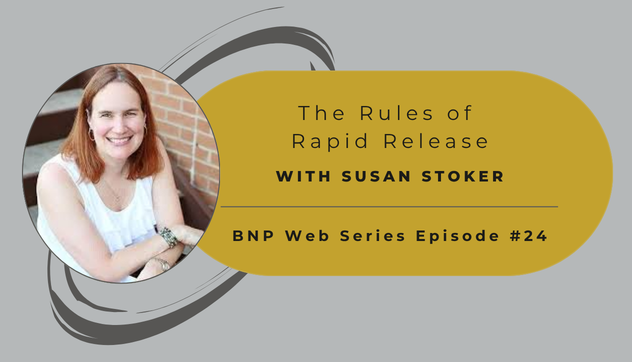
In this episode of the B&N Press Web Series, New York Times, USA Today, and Wall Street Journal bestselling author Susan Stoker joins us to break down what it really takes to sustain a rapid release publishing strategy.
With more than 120 books and a career built on consistency, Stoker offers a candid look at how high-volume publishing works in practice. From writing routines to series strategy, she shares how authors can build momentum without burning out, and why understanding reader behavior matters just as much as writing the next book.
If you have ever wondered how some authors publish multiple books a year while maintaining quality and growing their audience, this conversation delivers both practical guidance and a reality check.
Key Takeaways
● Rapid release is about staying in your readers’ consciousness and not chasing algorithms.
● A series of six to seven books hits the sweet spot: long enough to build investment, short enough not to intimidate new readers.
● Going wide across all platforms — including Barnes & Noble — is essential for bestseller list eligibility.
● Your writing process must become a non-negotiable habit, even if it’s just one hour a night or the notes app in the school pickup line.
● Write what you genuinely enjoy. Chasing trends in an unfamiliar genre is harder and usually less rewarding.
● Brand clarity is a superpower. When readers know exactly what they’re getting, trust compounds over time.
● Volume without quality is a dead end. Readers can always tell and they won’t come back.
Transcription
Julie Braunschweiger: Hello and welcome. Today, we are going to talk about the rules of rapid release. What does it really take to publish consistently at a high volume? And how can authors do it in a way that builds a long-term career without burning out?
I could not think of a better person to have this conversation with than bestselling author Susan Stoker. Susan is a New York Times, USA Today, and Wall Street Journal bestselling author who debuted her first series in 2014 and quickly followed it with her SEAL of Protection series, establishing herself as a go-to voice in reader-driven storytelling and military romance. She has built an incredible career creating stories readers can truly get lost in, all while maintaining a consistent and ambitious publishing schedule.
Susan, thank you so much for being here. I am so excited to talk about what really goes into rapid release.
Susan Stoker: Thanks, Julie. I appreciate it. I am honored you asked me to come talk about this. Publishing is a tough world right now with everything going on, but I do think consistency is key. I write series, not true standalones, and I am excited to dig into it.
Julie: When I keep seeing your name every single week on bestseller lists, I knew you were the right person to call. Let’s start at the beginning. Can you share a bit about your background and how you got into writing?
Susan: I had no intention of being a writer. I have always been a reader, though. When I was younger, I would go to the library, start at the A’s in the romance section, and just read everything I could get my hands on.
Professionally, I worked in academia. I married someone in the military, worked at a university on a military base, and eventually earned my doctorate. So yes, technically I am Dr. Stoker, but I always joke that I am a doctor of writing really long papers.
When eBooks started taking off around 2013, I began proofreading and thought, the stories I have sitting on my computer are just as good as some of what I am reading. So I got brave and published my first series. It sold maybe four copies.
But during that time, I paid attention to what successful authors were doing. I realized I needed a clearer niche. My first series was too broad, so I leaned into military romance. I married a man in uniform, I like men in uniform, so it felt natural. That first SEAL series did really well, and I built from there.
Julie: At what point did the consistent, high-volume release schedule become part of your strategy?
Susan: Early on, I just wanted to get books out quickly and stay visible. I was publishing frequently, sometimes every month. Back then, Kindle Unlimited was new, and there was a lot of opportunity.
I also wanted to hit bestseller lists, which meant going wide beyond Amazon. So I expanded to other platforms and kept releasing books to build momentum.
Then I had a moment where I realized I had made my yearly salary in a single month. That was when I thought, okay, I can do this full time.
Julie: How many books are you publishing now?
Susan: My 122nd book comes out in May. These days, I publish about six to eight books a year. It used to be closer to ten, but that pace is a lot, especially when you factor in everything beyond writing like audio, translations, marketing, and events.
Julie: That is still a lot. How do you make that sustainable?
Susan: First, I will say something that makes a difference. I do not have children. That gives me more flexibility with my schedule.
Beyond that, I rely on routine. I am a morning writer. I get up early, sit in my chair, and write while my brain is fresh. I usually write for three to four hours and aim for around five thousand words.
But I do not write every day. I work in bursts. I can write a full book in about three weeks, and then I take time off. That break is important. I need space to recharge and think about the next story.
Some people say you have to write every day, even if it is just a little. That does not work for me. I write intensely when I am in it, then step away.
Julie: I think that is an important point. Every author has to find what works for them.
Susan: Exactly. Some people write in the pickup line at school, some late at night, some dictate while walking. You have to find your routine and stick with it, but it has to fit your life.
Julie: Has your approach changed over time?
Susan: My books have gotten longer, so they take more time. And the business side has grown. Writing is maybe twenty percent of the job. The rest is emails, marketing, social media, audio production, translations, and more.
That is something people do not always realize when they say they want to be an author.
Julie: How far ahead are you typically writing?
Susan: I am usually several months ahead. I cannot write to tight deadlines. It would completely shut me down.
Right now, I just finished a book that comes out next year. Being ahead allows me to coordinate everything like audio and translations so they can release at the same time.
It also gives me a buffer. Life happens, and if something unexpected comes up, I still have books ready to go.
Julie: How do you manage multiple series and titles?
Susan: I used to rotate between several series at once, but I have changed that. Now I focus on releasing books closer together within the same series.
Readers today like to binge. If it takes too long to finish a series, you risk losing them. So I try to complete series more quickly.
I also introduce a new series before finishing the current one. That way, readers have something to look forward to next.
Julie: That really reflects how people consume content now.
Susan: Exactly. And I write my books so each one has a complete ending, but I include a teaser for the next story. Readers do not want to wait too long after that.
Julie: How do you approach your backlist?
Susan: I do not overthink it. Once a series is done, I move on. But I like to include Easter eggs. Characters from earlier books might show up again, or there might be references longtime readers recognize.
It rewards loyal readers without confusing new ones.
Julie: How do you maintain quality with such a high output?
Susan: I focus on character and emotion more than physical description. My characters live in my head emotionally.
I also rely heavily on my editor. A strong developmental editor is critical. They help shape the story and catch issues I might miss.
Julie: What does your publishing process look like?
Susan: I finish a draft and read through it once. Then it goes to my editor for two rounds of edits, followed by two rounds of proofreading.
That process takes about a month. After that, it moves into formatting, audio, and translations while I start the next book.
I also use long pre-orders, sometimes a year out, because I have trained my readers to expect that.
Julie: That is a lot of moving parts. For newer authors, where should they focus their time and budget?
Susan: Editing is the most important investment. You need someone who understands story structure and can tell you what is not working.
You can find proofreaders more easily, but a good developmental editor is key.
Julie: What are some common mistakes authors should avoid with rapid release?
Susan: First, finish what you start. If you are writing a series, commit to completing it.
Second, get the words on the page. Do not edit as you go. You cannot fix what is not written.
And third, do not sacrifice quality just to release faster. Readers will notice.
I also think it is important to understand reader behavior. Readers have a set number of authors they follow closely. If you disappear for too long, someone else can take your place.
You want to stay visible and keep them engaged.
Julie: That is such an important perspective.
Susan: And write what you enjoy. Do not chase trends if you do not love the genre. Readers can tell.
For me, readers know exactly what they are getting. I write consistent, familiar stories with strong characters and happy endings. That becomes a comfort read, and that consistency builds trust.
Julie: What do you have coming up next?
Susan: In May, I have Keeping Penny releasing, followed by more books in that series later in the year. I also have a new Delta Force series launching in September. Altogether, I have several more books coming out this year, all available for pre-order across platforms, including eBook and audio.
Julie: Amazing. Lots for readers to look forward to. Thank you so much for joining me, Susan.
Susan: Thank you for having me. And just remember, every author’s process is different. You have to find what works for you.
Julie: Absolutely. Thanks to everyone for tuning in. You can find this interview and more in the B&N Press Web Series. Until next time.
Rapid release is not just about speed. It is about understanding your readers, building a repeatable process, and delivering stories consistently over time.
Susan Stoker’s approach shows that success comes from a combination of discipline, flexibility, and a deep understanding of what readers want. For authors considering this path, the takeaway is clear: find your system, protect your quality, and keep showing up.
Editor’s Note: This transcript has been edited for clarity, length, and readability while preserving the intent and substance of the original conversation.


