
Writing inspiration often comes from the places we least expect. It could be a chance encounter, a reader’s comment, or a forgotten detail in history. For bestselling author Ciji Ware, those sparks of creativity have fueled her American Spy Sisters series, transporting readers into the intrigue and resilience of World War II. Ciji thought her journey with the series had ended after the third book. But inspiration arrived in a surprising way — through readers’ encouragement and a long-forgotten family connection.
In this guest post, Ciji shares how unexpected discoveries and real-life figures can breathe new life into storytelling. Her experience is a strong reminder. Every writer can find fresh ideas when they stay curious, dig deeper, and remain open to surprises. Her journey shows that writing inspiration is everywhere, whether you’re starting your first book or your fiftieth.
When Readers Spark New Writing Inspiration
A Guest Post by Ciji Ware
I truly thought after completing The Safety of Strangers – Book 3 of my American Spy Sisters series – that I didn’t have another WWII book in me.
Some five years of digging deeply into the horrors of that brutal war left me emotionally drained. Researching the devastating London Blitz and the ghastly details of Nazi prison camps was exhausting. Uncovering the struggles and dangers faced by young women recruited for Allied intelligence work added to the strain.
However, much to my pleasure, I soon learned that my series of books had sparked strong reader interest. Each novel stands on its own, yet all are set in the same time period, 1938 to 1946. The stories share settings in France and Britain, with characters inspired by real-life heroines and heroes. Readers began clamoring for “just one more.
Discovering Inspiration in Forgotten Details
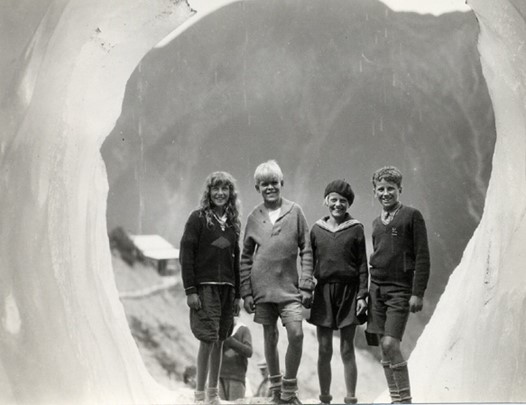
L Lawson Cook, Billy Peabody, Polly Peabody, Howard Cook
Inspired by comments and reviews following Book 3’s publication in 2023, I dipped back into one of the principle sourcebooks I’d discovered, Americans in Paris – Life and Death Under Nazi Occupation by Charles Glass. One afternoon, close to dozing off in my leather office chair, I ran across a name I had missed. It read: “Polly Peabody of Boston, Massachusetts,” a privileged 22-year-old debutante raised primarily in Europe.
My breath caught and I called out to my husband, “Didn’t your father fall in love with somebody named ‘Polly Peabody’ when your grandparents lived in France before the war?”
“Yes,” he confirmed from the next room. “Dad was crazy about her!” I had a vague memory of my late father-in-law waxing nostalgic about “beautiful Polly Peabody of Boston.” He had met her as a teenager at a summer camp on the edge of a lake in the French Alps. My husband soon found a photograph of Polly and Howard Cook, age fourteen, standing with their siblings in front of a glacier in Chamonix.
Could there be two Polly Peabodys from Boston living in France as WWII broke out?
How Real History Fuels Creative Writing
Thanks to my loyal readers and the lightbulb moment spotting Polly’s name, I set off chasing a story about “Debs at War.” I discovered the contributions these women made while fighting the Nazis. But what had become of Polly during those years? Drilling down various Internet rabbit holes, I found a print article quoting her granddaughter about her Boston Brahmin forebear: “We think my Grandmother was a spy.”
Bingo! I had a jumping off spot for Book 4, The Spy Wore Long White Gloves, debuting (pardon the pun) October 14 of this year.

Polly and other American and British debs my research eventually turned up morphed into my heroine ‘Lacy Farrington Forbes,’ a reluctant deb speaking finishing-school German who wants to be a war correspondent. Due to a wild set of circumstances, she becomes, instead, an operative in MI5, ferreting out German spies infiltrating Britain prior to a threatened invasion by Hitler’s storm troopers. Falling in love with a married, Harvard-trained doctor assigned to design hospital trains in Britain, she is soon risking her life at every turn. Thanks to readers who clearly love immersing themselves in the lives of feisty Americans navigating perilous situations while coping with English snobbery and misogyny rampant during WW II, Lacy becomes a character considered a traitor to her class.
Why Sharing History Deepens Writing Inspiration
 Not only has the American Spy Sisters series created its own cadre of readers, but at every book launch party held, many attendees turned up in WWII attire to join the celebration! Spy Sister fans are also part of a much larger community fostered by such brilliant novels as Kristin Hannah’s The Nightingale, Tatana de Rosnay’s Sarah’s Key, Ken Follett’s Winter of the World, Annie Barrows and Mary Ann Shaffer’s The Guernsey Literary & Potato Peel Pie Society, and Anthony Doerr’s All the Light We Cannot See – and scores more. WWII historical fiction fans have inspired an entire genre as more secret intelligence files were declassified over the years.
I’ve often wondered if our devoted readers have any idea how much it means to a writer to hear that the work they’ve slaved over has prompted a desire to delve more deeply into nonfiction works on the same subject? As a former journalist for 23 years, I write an Author’s Note at the end of each of my novels, relating the factual underpinnings of the story while disclosing what parts of the tale are pure fiction. I also offer a selected nonfiction Bibliography for anyone wishing to learn more about certain aspects of the WW II era. The appreciation of my readers for this ‘final note’ has been an inspiration both to my writing and my career itself … and for that, I am deeply grateful.
Every author experiences twists and turns, but staying open to the unexpected makes all the difference. Readers and hidden details waiting to be uncovered transformed her exhaustion into renewed energy. For any writer seeking writing inspiration, the lesson is clear: discover the stories that are everywhere around you.
About Ciji Ware
New York Times and USA Today bestselling author and Emmy Award-winning former broadcast journalist Ciji Ware has published fourteen historical and contemporary novels. She has also written a novella and two nonfiction works.
Her honors include the Dorothy Parker Award of Excellence, a Silver Gavel from the American Bar Association, and a DuPont Award for Investigative Journalism. She was named a Fellow of the Society of Scottish Antiquaries (FSAScot) for her historical novel Island of the Swans.
The Martha’s Vineyard Writer-In-Residence program selected Ware. In 2012, she was shortlisted for the WILLA (Cather) Literary Award for A Race to Splendor.
A graduate of Harvard with a degree in history, Ware is the first woman graduate of the college to serve as president of the Harvard Alumni/ae Association, Worldwide.
She lives in the San Francisco Bay Area with her husband of long duration. When not writing, she takes ballet barre classes through the San Francisco Ballet School’s Zoom program, performs in amateur theatricals, and walks just under ten miles a week with the Sausalito Dog Walkers.


