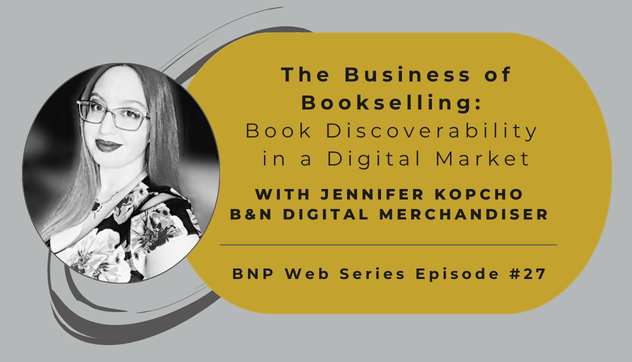
Book discoverability has never been more important, with millions of titles available at readers’ fingertips. But what goes into helping readers find their next great read? From digital merchandising and promotions to social media and word of mouth, bookselling is ultimately about connecting the right book with the right reader.
In this episode of the B&N Press Web Series, we sit down with Jenny Kopcho, Digital Merchandiser for NOOK Devices, eBooks, and Audiobooks at Barnes & Noble, to discuss the business of bookselling and how reader discovery has evolved in an increasingly digital marketplace.
Key Takeaways
● Digital bookselling is still bookselling. While the experience is different from a physical bookstore, the goal remains the same: connecting readers with books they’ll love.
● A strong, easy-to-read cover is one of the most important discoverability tools for authors, especially when viewed as a small thumbnail or in black and white on an eReader.
● Keep titles clear and concise. Tropes, keywords, and other selling points are often better suited to a book’s description than an overly long title.
● The opening line of a book description matters. A strong hook should quickly communicate the book’s genre, vibe, or central premise and encourage readers to keep reading.
● Word of mouth remains one of the most powerful drivers of book discovery, whether recommendations come from friends, book clubs, social media, libraries, or online reading communities.
● Digital merchandising is collaborative. Booksellers consider reader behavior, trends, publisher input, promotions, sales data, and cultural conversations when building collections.
● Getting included in a promotion is only the beginning. Authors can amplify that opportunity through social media, newsletters, and their own reader communities.
● Indie books are often ahead of larger publishing trends because independent authors can experiment with niche genres, tropes, and reader interests.
● There is an audience for nearly every kind of book. The challenge is finding those readers and giving word of mouth the opportunity to grow.
Watch the Full Episode
Full Transcript
Julie: Hello everyone, and welcome. With millions of books available at readers’ fingertips, discoverability has never been more important. But what goes into helping readers find their next great read? How do booksellers think about merchandising, promotions, and creating meaningful browsing experiences in a digital marketplace?
To talk about the business of bookselling, I’m joined by Jenny Kopscho, Digital Merchandiser for NOOK Devices, eBooks, and Audiobooks at Barnes & Noble.
Now in her eighteenth year with the company, Jenny began her career as a bookseller, connecting readers with books one customer at a time. Today, she helps shape the digital discovery experience for millions of readers across Barnes & Noble’s eBook and audiobook platforms.
Jenny, I’m so excited to have you back. Can you start by telling us a little more about your role and how you made the move from bookstores to the eBook and audiobook side of the business?
Jenny: I started working in stores in the late 2000s and worked my way through almost every department—the movie department, kids, newsstand, the NOOK kiosk, and the regular book floor. I worked in several different stores and made a lot of connections along the way.
Eventually, one of those connections moved into the corporate offices. When they were looking for someone to fill a digital merchandising role for eBooks, I was recommended.
Julie: And what does a digital merchandiser actually do?
Jenny: I take care of the virtual placement of books. I build the collections you see when you open your NOOK app or shop digitally, and I write the copy for the carousels on the website.
I think of those carousels as digital bookshelves. I’m choosing which books belong on those shelves and putting together collections that make sense for readers. Instead of putting books on a physical table, I’m putting them into a digital space.
Julie: So, in a lot of ways, you’re doing what you did as a bookseller in stores, only online. What does good bookselling look like in a digital environment?
Jenny: It’s definitely a different experience. When you have a customer standing in front of you, you can ask questions and figure out exactly what they’re looking for.
In the digital space, we learn from how readers search, browse, and interact with what we put in front of them. It takes more research and looking ahead at trends—seeing what people are talking about in book communities and figuring out what readers might want, even if they don’t necessarily know they’re looking for it yet.
Julie: When a reader lands on BN.com, the NOOK app, or a NOOK device, what kind of experience are you trying to create?
Jenny: I take different approaches depending on where the reader is shopping.
On NOOK devices, I want the experience to be more of a snapshot of what’s happening right now. I might highlight our best picks for the month, Book Club selections, or read-alikes for books everyone is already talking about.
Because there’s less space on a device and readers may open it several times a week, I rotate those selections more frequently.
The website is different. Someone may visit less frequently or arrive looking for something very specific, so collections can stay up longer. There’s also much more room to explore different subjects and categories.
With the new BN.com experience, we’ve been able to build out more specific eBook and audiobook pages. For indie books, for example, we can now create dedicated pages for indie fiction, romance, mystery, and other categories. That gives us more opportunities to put those books in front of the right readers.
Julie: How do you decide which books get featured in those collections?
Jenny: A lot of it is collaborative. I work with you and the rest of the team on ideas and themes. We also look at what’s happening in the digital space and on social media. What are people talking about? What books or themes are rising to the top of those conversations?
We also work with publishers. They let us know about upcoming releases, promotional opportunities, and books they’re discounting.
But it’s a balance. Publishers don’t dictate what we feature, and I don’t make decisions based solely on my own personal taste either. There’s a lot more collaboration behind digital merchandising than people might realize.
Julie: How has reader discovery evolved over the last several years? Are people finding books differently today?
Jenny: It’s hugely different, but also the same.
Book discovery has always been grassroots and driven by word of mouth. When I worked in stores and customers came in asking for a particular book, if you asked how they heard about it, the answer usually involved another person: a friend recommended it, they saw someone talking about it, or a celebrity they liked was reading it.
That hasn’t changed. Social media has just expanded it.
BookTok is a community of readers who love talking about books and sharing what they’re reading. Book clubs work the same way. When people love a book, they want to talk about it.
Julie: It’s almost like the water-cooler conversation around a favorite television show. We love talking about stories we find compelling.
Jenny: Exactly. I was working in stores when Fifty Shades of Grey first became popular, before it was traditionally published. Customers were coming in asking for this print-on-demand book because they had heard about it from other readers.
That word of mouth eventually helped propel the book into something much bigger. When readers get behind a book in large numbers, it can have a tremendous impact.
Julie: Speaking of self-publishing, many of the people watching are B&N Press authors or are considering publishing their own books. What should authors focus on to improve their discoverability?
Jenny: I think one of the most important things is the cover. You want a simple, clean design that is easy to read.
People say not to judge a book by its cover, but in the digital space, that cover is often the first thing a reader has to go on. If you’re browsing pages of books, you don’t see the description until you click through. The cover has to make you want to do that.
Julie: And authors have to think about how that cover looks as a thumbnail, too.
Jenny: Exactly. You’re seeing it in a very small space. And with NOOK, I also have to think about how covers look in black and white.
There are covers that look beautiful in print but become difficult to understand when they’re converted to black and white and reduced to thumbnail size. You might not be able to read the title or tell what you’re looking at.
That doesn’t mean authors shouldn’t design for print if that’s their priority. But if you’re publishing digitally, it’s something to keep in mind.
Julie: Authors can also consider whether the same exact cover needs to be used across every format.
Jenny: Right. We already see different covers for the same book all the time. Movie tie-in editions are an obvious example, but there are also special editions and alternate covers.
There can be reasons to create variations depending on the format and how readers are going to encounter the book.
Julie: Beyond the cover, what other elements of an online book listing can help turn a casual browser into a buyer?
Jenny: I think having a clear title helps. There’s a trend in the digital space where authors put almost the entire description of the book into the title—all the tropes, the genre, the year, everything.
I don’t think that’s necessarily what readers are looking for. The cover and title should give readers a snapshot of what you’re trying to portray. Those additional selling points can go into the description.
Julie: And descriptions are obviously another important part of the product page. What makes a good one?
Jenny: The first line is incredibly important. When I talk to readers, many of them look at that first sentence and decide whether they want to keep going.
You want that elevator pitch—the one line that sums up what the book is about or the feeling you want it to evoke.
People move through content quickly. You don’t necessarily need an enormous description to get someone interested.
Julie: What makes a strong hook?
Jenny: Personally, I like something that communicates both the vibe and the plot. Tell me how the book is supposed to make me feel, what kind of genre or subgenre I’m getting, and give me a glimpse of what the story is actually about.
That also makes our jobs easier as booksellers. When those elements are clear, it helps us understand which promotions, collections, or read-alikes a book might fit into.
Julie: Speaking of promotions, what can authors do once their book has been included in one?
Jenny: Talk about it.
Use your social media. Reach out. If NOOK is promoting your book, ask whether you can share the creative or whether we can tag you. There are actual people behind these decisions, and we want authors to succeed.
If we can help amplify something by tagging an author or reposting their content, that benefits everyone.
Julie: I think that’s really important. Some authors might think, “My book made it into a collection, so I’m done.” But getting into the promotion is really just the first step.
Now you have an opportunity to tell people about it. Share it on social media. Put it in your newsletter. Tell your readers.
Those additional sales can help a book move up in rankings, which can lead to more visibility elsewhere on the site.
Jenny: Absolutely. We’ve had collections where one title suddenly starts selling particularly well. Then that title begins appearing in bestseller carousels on genre and subcategory pages, putting it in front of even more readers.
There’s a lot of opportunity in the digital space.
Julie: Looking ahead, are there trends or opportunities in digital bookselling that authors should be watching?
Jenny: Trends are very circular. Romance tropes like enemies-to-lovers or second-chance romance continue to be popular, but many of those trends come back around again and again.
Julie: I would also say that if you’re looking for the next big trend, indie books are a great place to start.
Indie authors have been publishing things like hockey romance and other highly specific niches for years before they become larger trends. Independent publishing gives authors the ability to be very experimental and very niche.
Jenny: Libraries are another great place to look. Librarians often have their ears to the ground and know what readers are asking for and what’s coming next.
Julie: Let’s finish with a lightning round. What’s the most underrated discoverability tool?
Jenny: Your best friend. If they’re a reader, they’ll probably tell you about something you weren’t expecting.
Julie: I love that. What eBook or audiobook growth area are you watching?
Jenny: Audiobooks. It’s an area that continues to expand, and I’m an audiobook convert myself.
One area I’m particularly interested in is biographies and memoirs narrated by the person who wrote them. Readers actively seek those out because the author adds something special to the listening experience.
Julie: What’s one thing every author should check before publishing?
Jenny: Spelling! Make sure your formatting and spelling are correct.
Beyond that, make sure you have a clear plan for your cover, title, and description.
Julie: And look at your cover in black and white. Even something as simple as turning it black and white in a design program can show you how it might appear on an eReader.
Last question: What do you think authors worry about too much?
Jenny: I think every author I’ve ever talked to worries that nobody is going to read what they wrote.
But there is a market for everybody. Every niche has someone out there who wants to read it. The hardest part is finding those people.
The internet and social media have actually made it easier to find those smaller communities. If ten people read your book and love it, they might tell ten other people. That’s how it starts.
It all comes back to word of mouth.
Julie: Jenny, thank you so much for joining me and sharing your insights into the business of bookselling and what it takes to connect books with readers in a digital marketplace.
For authors who are ready to publish and sell their own books, B&N Press is our self-publishing platform. And if you’re simply looking for your next great read or listen, be sure to explore the latest eBooks, audiobooks, new releases, and deals available online and on NOOK.
Thank you again, Jenny, and thanks to everyone for watching. We’ll see you next time for another conversation in the B&N Press Web Series.
Editor’s Note: This transcript has been edited for clarity, length, and readability while preserving the intent and substance of the original conversation.


